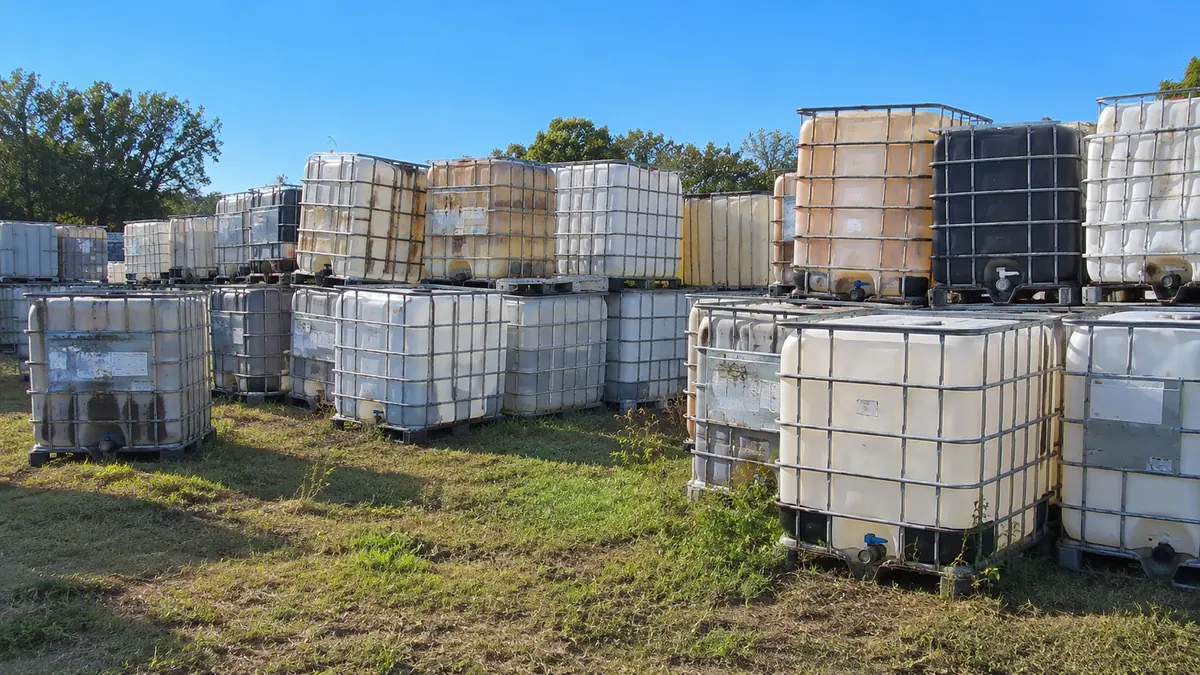
Start with the right container
Food grade. Not technical grade, not as-is, not “it only had soap in it”. If you are growing something you intend to eat, start from a container whose entire documented history is food, and get that history in writing.
A 275 gallon bottle cut horizontally gives you two beds roughly 46 by 38 inches and about 20 inches deep, which is a genuinely useful size — deep enough for carrots and tomatoes, narrow enough to reach the middle from either side.
Taking it apart
Unbolt the cage from the base first. Most are held with four to eight galvanised bolts and a socket set handles it in ten minutes. Keep the bolts.
Lift the cage off over the bottle. On some designs the cage is welded as a basket and simply slides up; on others you will need to unclip a top rail. Do not cut it — you want the cage intact.
Cut the bottle with a jigsaw and a fine-tooth blade, slowly. HDPE melts rather than chips if you rush it, and a melted kerf welds itself back together behind the blade. Mark your line with tape, support both halves, and take your time.
Dress the cut edge with a file or a quick pass with a heat gun to soften the burrs. Bare cut HDPE is sharp enough to open a thumb.
Drainage, fill and the bit people get wrong
Drill drainage. A dozen half-inch holes across the base, not three, and not in a neat line down the middle — spread them. Then lay landscape fabric inside so your compost does not wash straight out of them.
Do not fill the whole depth with compost. The bottom six inches can be coarse material — broken terracotta, wood chip, the offcuts from the bottle itself — which saves a lot of money and improves drainage. Compost on top of that.
Raise the bed off the ground on the reclaimed pallet base or on timbers. A plastic bed sitting directly on soil holds water underneath and the base will stay permanently damp, which is fine for the plastic and less fine for whatever is living under it.
The cage is the best part
Cut the cage in half vertically with an angle grinder and you have two excellent trellis panels, already galvanised, already rigid, already the right size to bolt to the long side of each bed. Tomatoes, beans, cucumbers and peas will all climb it happily.
File the cut ends and either paint them or fit plastic caps. Galvanising does not protect a cut face, and that is where rust will start.
The leftover pallet base, if it is poly, makes a perfectly good standing platform or a tool tray. If it is wood, compost it. If it is steel, somebody at your local scrapyard will give you coffee money for it.
Two honest caveats
Black or dark-painted beds in a hot climate will cook roots on the sunward side. If you are south of about the 35th parallel, either keep the bed pale, shade the sunward face, or accept that the edge planting will struggle in July.
And paint the outside regardless. A translucent bottle full of damp compost in sunlight grows algae on the inside of the wall, which looks unpleasant and competes for nutrient. Two coats of exterior latex solves it for several years.
Written at 9003 Governors Row, Dallas. We publish these without a newsletter wall because gating a specification behind an email address is a small, petty thing to do. If something here is wrong, email us and we will correct it.