Decision one: the container
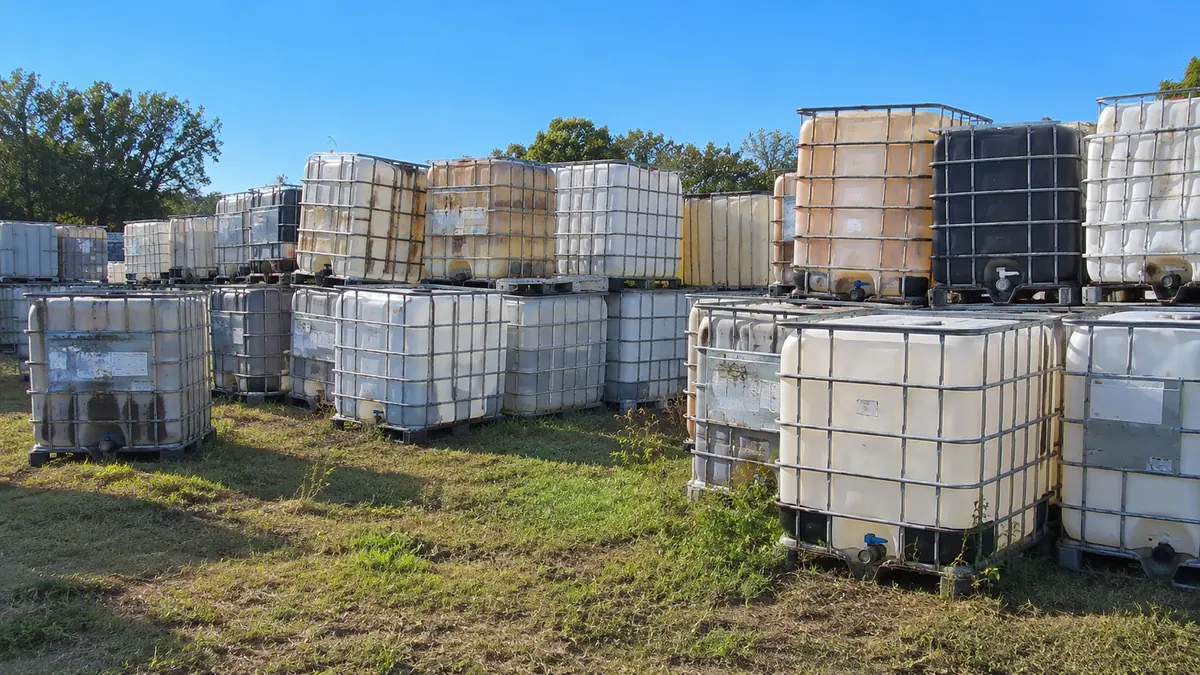
Food grade, documented, no exceptions. If there is any chance a human will drink this water, the container's entire history needs to be food and you want that in writing.
A new or rebottled tote is the belt-and-braces answer and costs more. For most households a documented food-grade unit that carried juice concentrate or liquid sugar is entirely appropriate.
Do not use an as-is or technical tote for this under any circumstances, regardless of how clean it looks or what you intend to do to it first.
Decision two: light and siting
Light causes algae and algae causes everything else. Paint the bottle with two coats of dark exterior latex, or store it somewhere genuinely dark. A garage corner, a shed, a north wall under cover.
Keep it off concrete if you can — a pallet or timbers underneath. Prolonged contact between HDPE and some concrete additives is not ideal, and the air gap helps with temperature too.
Cool and stable beats cold and swinging. A garage is usually better than outdoors even in a mild climate.
Decision three: treatment and rotation
Fill with potable water from a treated supply. If your supply is chlorinated, the residual does useful work for a while. If it is a private well, treat on filling.
Rotate. Every six months is a reasonable household interval — drain it onto the garden, rinse, refill. A tote of water that has sat for three years is not an emergency supply, it is a project.
Store a means of treating it at the point of use regardless: a filter, tablets or an understanding of boiling. Stored water is not sterile water, and the container is only one part of the chain.
Decision four: the plumbing and the weight
275 gallons of water weighs about 2,290 pounds. That wants a flat, continuously supported base — a slab, pavers on a compacted base, or heavy timbers across the whole footprint. Never four blocks under the corners.
Fit a hose adapter to the 2 inch outlet and a ball valve. Nine dollars and twelve dollars respectively, and the difference between usable and theoretical.
If you want gravity pressure, elevation buys you about 0.43 PSI per foot. A tote on a four-foot stand gives roughly 1.7 PSI, which runs a hose slowly and drip irrigation well, and will not run a shower. Anything higher needs an engineered stand — this is a lot of weight above head height.
Fit an overflow if it is outdoors and catching anything. A full tote in a storm will find its own route out, and you would rather choose where.
The honest limitations
Freezing will deform a full bottle and can split a cage weld. In hard-freeze country, store it in a space that stays above freezing or leave headspace and accept the risk.
A single 275 is roughly a two-week supply for a family of four at one gallon per person per day for drinking and basic sanitation. That is a useful reserve, not an indefinite one.
And it is heavy, awkward and not portable. If your scenario involves leaving, this is the wrong storage format entirely.
Written at 9003 Governors Row, Dallas. We publish these without a newsletter wall because gating a specification behind an email address is a small, petty thing to do. If something here is wrong, email us and we will correct it.