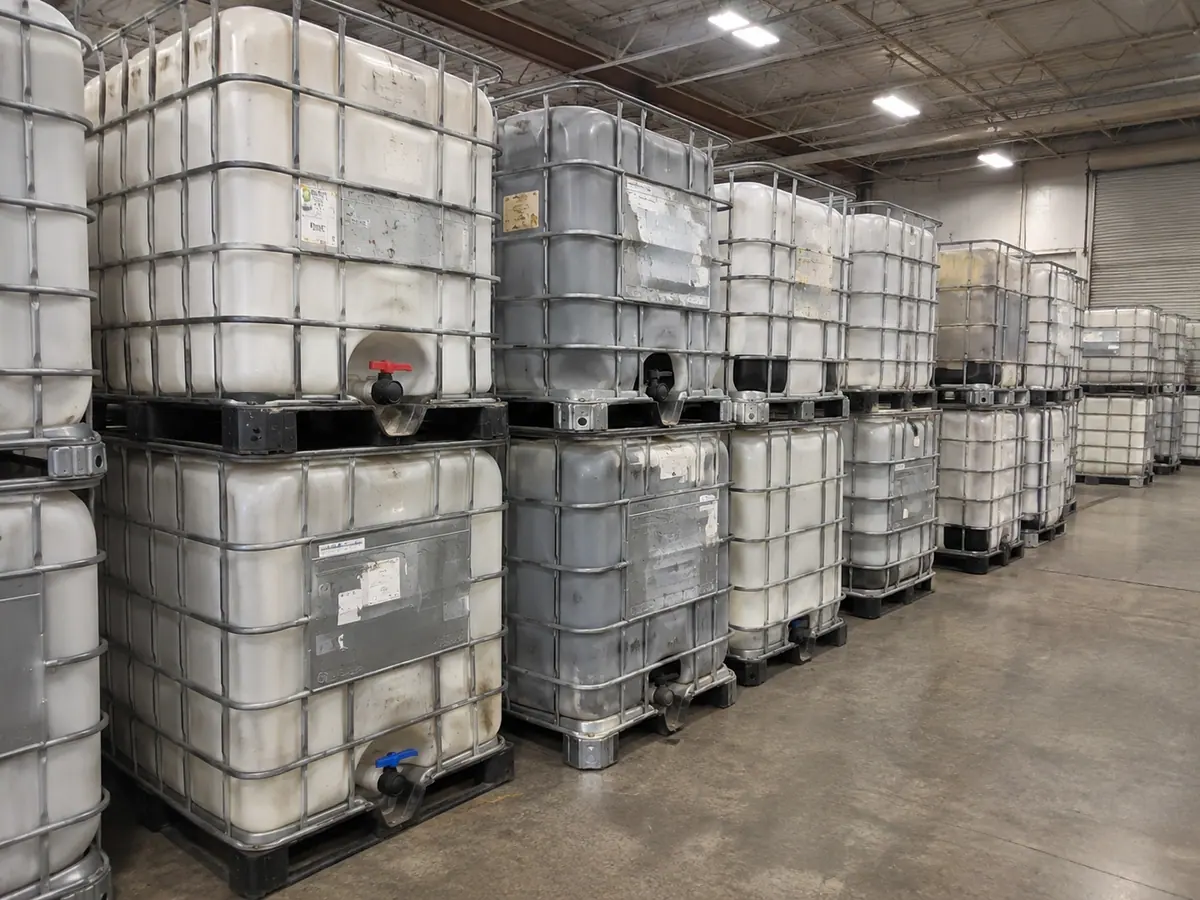
The mistake, stated simply
People buy a container rated at a gross weight, read the capacity in gallons, and fill it to the capacity. That works perfectly for water and fails for a surprising number of ordinary industrial liquids.
Water is 8.34 pounds per gallon. A full 330 gallon tote of water is about 2,752 pounds of product plus 160 pounds of tare, which puts you at roughly 2,912 pounds against a gross rating around 2,970. You are within limits by two percent. There is no margin left for anything heavier.
Running the numbers for your product
Take your product's specific gravity from the safety data sheet. Multiply it by 8.34 to get pounds per gallon. Multiply that by the volume you intend to fill. Add the tare weight stamped on the nameplate. Compare the total against the gross rating, also on the nameplate.
If the answer exceeds the rating, you do not get to fill to capacity. You work backwards instead: subtract the tare from the gross rating, divide by your pounds per gallon, and that is your maximum fill volume. Write it on the tote in paint pen, because the next person will not do this calculation.
A worked example. Sodium hydroxide at 50 percent has a specific gravity around 1.53, so 12.76 pounds per gallon. In a 330 gallon tote with a 2,970 pound gross rating and 160 pounds of tare, you have 2,810 pounds of payload available, which is 220 gallons. You just bought a 330 and you can legitimately use two thirds of it.
Why the 275 often wins for dense products
This is the counterintuitive part. For anything much heavier than water, a 275 gallon tote filled to capacity frequently carries more usable product per container than a 330 filled to its weight limit, and it costs less, stacks better and ships double-stacked as an empty.
The cost-per-gallon advantage that justifies buying a 330 only exists if you can actually fill it. For brine, caustic, liquid sugar, glycol and most acids, you cannot.
What failure looks like
Overloaded cages do not usually burst. They deform. The uprights bow outward near the base, the bottle takes on a pronounced belly between the bars, and the whole assembly becomes unstable to lift. If you have ever seen a tote that sits visibly wider at the bottom than its neighbours, that is what you are looking at.
The dangerous moment is not storage, it is handling. An overloaded container that has sat quietly for months will fail when a forklift picks it up unevenly, and it fails all at once. Do the arithmetic. It takes a minute and it is the single highest-value minute in this whole article.
Written at 9003 Governors Row, Dallas. We publish these without a newsletter wall because gating a specification behind an email address is a small, petty thing to do. If something here is wrong, email us and we will correct it.