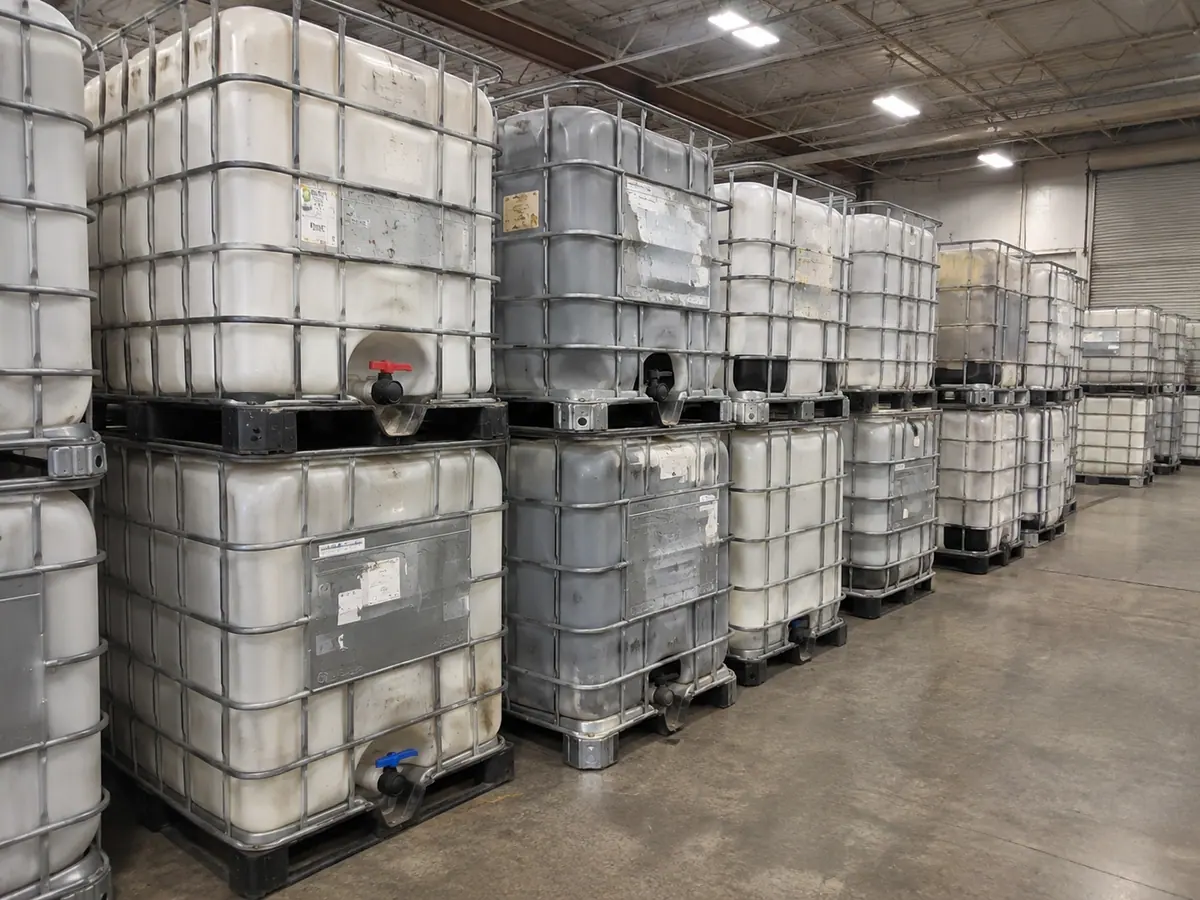
Inside the operation · 9003 Governors Row
Eleven stations. Forty minutes. One refusal rate we are proud of.
This is the part of the business nobody photographs for a brochure, and the part that decides whether the container you receive holds pressure. We are going to walk you through all of it, including the station where we say no.
Want your own totes washed?
Quote, pickup, or recycling — one form.
Toll washing is a real service. We need documented prior contents before the truck leaves your site — put them in the message field.
Free, no-obligation quote. Orders and tote pickups are fulfilled through our regional IBC supplier network.
The gate
It starts with a refusal, not a rinse.
Before a tote touches water it goes through intake, and intake is mostly about saying no. Roughly one arrival in eight is turned away at the gate or routed straight to destructive recycling.
That refusal list is short and it does not bend:
- Unknown or unlabelled prior contents
- Restricted-use pesticides
- Acutely toxic products of any kind
- Crystallised or polymerised residue we cannot remove safely
- Anything mixed on site by somebody who cannot tell us what they mixed
Refusing at the gate costs revenue and it is the single most important quality control step in the entire operation, because every downstream station assumes the container in front of it is something we understand.
“If you cannot name what was in it, you cannot name what comes out of it.”Wash line SOP, revision 14
- 180 °F CAUSTIC
- THREE FRESH-WATER RINSES
- CONDUCTIVITY CHECKED ON RINSE 3
- 4 PSI HELD TEN MINUTES
- ONE POUND DROP IS A FAILURE
- 23 GALLONS FRESH WATER PER TOTE
Station by station
All eleven, in order.
Intake and refusal
Nameplate photographed, prior contents established. Unknown contents, restricted-use pesticides and acutely toxic products are refused at the gate — roughly one arrival in eight.
Residual drain and capture
Remaining product goes to a sealed recovery tank and is manifested for proper disposal. Nothing is poured onto ground or into a drain.
Cold pre-rinse
Knocks down bulk residue using clarified water recovered from earlier cycles, not fresh water.
Hot caustic wash
A spinning head runs 180 °F caustic solution for about nine minutes inside a 275 gallon bottle.
Triple fresh-water rinse
Three rinses, with conductivity checked on the third. A high reading sends the tote around again rather than onward.
Forced-air dry
Heated air through the bottle until dry, because a wet bottle shipped sealed grows things nobody wants.
Cage straightening
Bent uprights corrected on a hydraulic jig; fork pockets checked for square with a gauge.
Valve teardown
Valve stripped, seat inspected, gasket and handle replaced. Scored bodies are swapped, not nursed.
Lid and gasket
New lid seal, new dust cap. The cap is the cheapest part on the tote and the one most likely to be missing.
Pressure test
4 PSI held for ten full minutes under a witnessed gauge. A one-pound drop is a failure.
Grade, label, photograph
Grade assigned from prior contents, lot letter applied, unit photographed into the record before it joins sellable stock.
The test
Four PSI, ten minutes, and a witnessed gauge.
| Parameter | Value | Why |
|---|---|---|
| Test pressure | 4 PSI | Well above any service pressure a gravity-fed tote will see |
| Hold time | 10 minutes | Long enough for a slow seep to register on a gauge |
| Pass criterion | No measurable drop | A one-pound loss is a failure, not a rounding error |
| Witness | Operator sign-off against unit ID | So the result belongs to a specific container |
| First failure | Return to line | Usually a gasket or a seating issue, not the bottle |
| Second failure | Condemned | Bottle to granulator, cage to baler |
| Record | Result + photograph | Stored against the unit before it joins stock |
Grade assignment
Washing changes condition. It does not change history.
This is the point most buyers misunderstand, and the point where dishonest sellers make their money. Grade is decided by prior contents first and appearance second.
| Documented prior contents | Condition | Grade assigned |
|---|---|---|
| Food product, single fill | Clean, no crazing, intact fittings | Food grade |
| Food product, single fill | Staining or a scarred valve seat | Technical grade |
| Non-hazardous industrial chemistry | Passes wash and test | Technical grade |
| Non-hazardous, water-rinsed only | Clean to the touch, odour possible | Rinsed |
| Known non-hazardous, not washed | Empty, sound, prior contents disclosed | As-is |
| Any history, new bottle fitted | New interior, reclaimed cage | Rebottled |
| Unknown | Any condition whatsoever | Not sold — regrind |
Note the last row. A spotless container with no provenance is not a bargain, it is a liability, and we will not put a grade on it no matter how good it looks.
Questions
What people ask when they tour the yard.
01Can I visit and watch?
02What happens to the wash water?
03Do you ever wash a tote twice?
04How do you know the caustic is still effective?
05What is the single most common failure?
Come and look at the line.
Weekday mornings at 9003 Governors Row. Closed-toe shoes, email first, and we will show you the pressure test rig that the whole company was built around.