Start with the grade, as always
Food grade. Animals drinking from a container all day every day are in exactly the same position as a recirculating hydroponic system: continuous exposure, no dilution, and weeks of accumulation.
Residual surfactant causes refusal before it causes illness — stock will simply drink less, which in summer is its own serious problem. A reduced water intake shows up as reduced feed intake and lost condition long before anybody suspects the tank.
Algae is the main battle
Warm water, sunlight through a translucent wall, and a little organic input from the animals themselves is a perfect algae culture. Within weeks you have a green tank, and in hot weather you can get blooms that genuinely harm stock.
Block light completely. Paint the bottle, two coats, dark colour. Shade the installation if you can. Keep the lid on and screened, both to keep light out and debris and wildlife from getting in.
Flow helps. Stagnant water goes off; water that turns over every few days does not. Size the tank to your actual daily draw rather than to the largest tote you can afford.
Building a trough rather than a tank
A half-cut tote makes a serviceable trough and the cage base keeps it stable. Cut horizontally with a fine-tooth jigsaw blade, dress the edge with a file, and cap it — bare cut HDPE is sharp and stock will lean on it.
Leave the lower half intact including the outlet valve, which becomes your drain for cleaning. A trough you cannot drain is a trough nobody cleans.
Keep the cage around it. Animals lean, and 200 gallons of water in an unsupported half-bottle will bow outward and eventually split at the base corner.
Nurse tanks and moving water
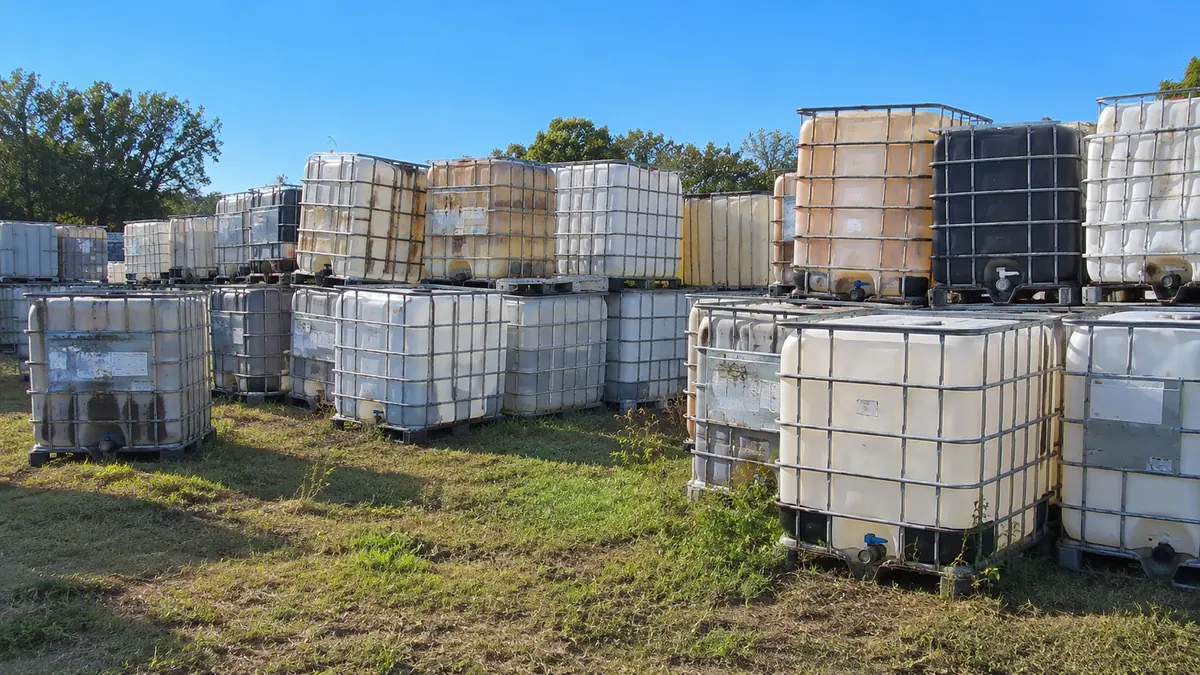
For hauling water to remote paddocks, a 275 strapped on a flatbed or trailer is standard practice and it works. Strap across the cage, not over the bottle, and strap it properly — 2,290 pounds of water moving independently of your vehicle is a genuinely dangerous event.
Baffling matters on anything but short, slow runs. A part-full tote surges, and the surge arrives at the strap and the trailer bed as a shock load. Either run full, run nearly empty, or accept slow speeds.
Fit a hose adapter to the 2 inch outlet — nine dollars — and the whole operation becomes a great deal less messy.
Winter
A full tote freezes from the top and the sides inward, and expanding ice will deform a bottle and split a cage weld. In hard-freeze country either drain between uses, keep flow going, or insulate and heat.
If you heat, use a thermostatically controlled system and keep the product below 120 °F. We have seen a stock tank heater left uncontrolled turn the bottom of a bottle into a saddle shape.
Written at 9003 Governors Row, Dallas. We publish these without a newsletter wall because gating a specification behind an email address is a small, petty thing to do. If something here is wrong, email us and we will correct it.