Spring: the structural pass
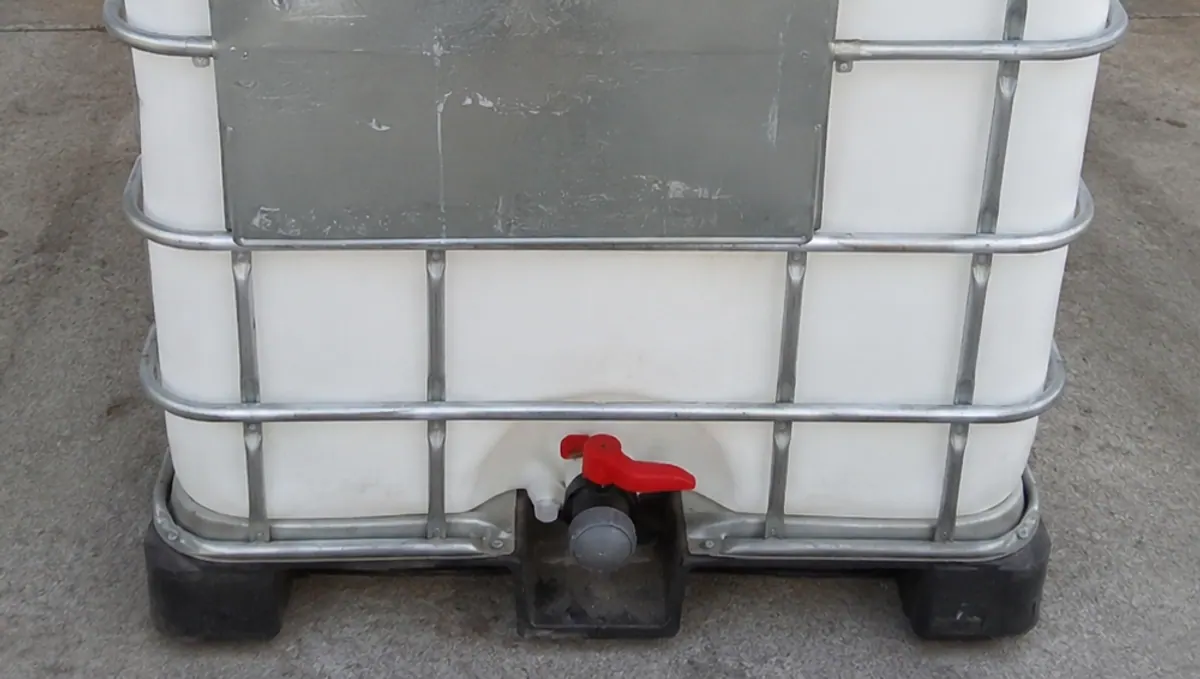
Winter is hard on containers and spring is when the damage is visible. Walk the fleet and sight along the cage uprights for bowing, check corner welds for cracks, and look at base corners for forklift damage.
Check fork pockets are square. A deformed pocket is the beginning of a dropped tote.
Any unit that rocks on a flat floor has a twisted frame and comes out of the stacking rotation immediately.
Straighten what can be straightened, replace bases at fifty-eight dollars rather than replacing containers, and scrap what has failed at more than one weld.
Summer: the ultraviolet and seal pass
Run a bare hand over the sunward face of every outdoor unit. Chalk on your palm means the surface has degraded and the clock is running.
Look across the surface at a low angle with a torch for crazing. Anything crazed gets pressure tested before it is trusted again.
Replace lid gaskets on anything stored outdoors. Heat and sun harden them and a hardened gasket is the commonest slow leak there is.
Repaint or re-cover anything translucent that is living outside. This is the cheapest intervention on this entire list and it buys years.
Autumn: the winterising pass
Test every heater before you need it. Elements fail quietly over a summer in storage and January is a poor time to discover it.
Check thermostats and sensors are reading correctly and are positioned against the bottle wall rather than in the airspace.
Inspect insulating jackets for damage and refit anything that has been unlaced and left.
Drain and stow anything water-filled that is not going to be heated. Ice deforms bottles and splits cage welds, and it does it once.
Winter: the paperwork pass
The quiet months are when to do the administrative work nobody enjoys. Photograph and transcribe nameplates across the fleet so you know where each unit sits against its five-year clock.
Reconcile your count. Find out how many containers you actually have versus how many you believe you have, because those numbers diverge every year.
Review prior-contents records and make sure each unit's history is still attached to it in a way somebody else could follow.
And order ahead for spring. Fertigation and de-icer demand both spike, and the buyers who place orders in the quiet months get a truckload rate instead of an LTL one.
The running stock to keep
Two gaskets and two dust caps per tote in the fleet, a couple of spare valve bodies, one spare base per twenty units, and a galvanised bolt set. Perhaps a few hundred dollars in total.
That shelf is the difference between a ten-minute repair and a container standing idle for a week waiting on a parcel, and it is the single highest-return thing on this page.
Written at 9003 Governors Row, Dallas. We publish these without a newsletter wall because gating a specification behind an email address is a small, petty thing to do. If something here is wrong, email us and we will correct it.