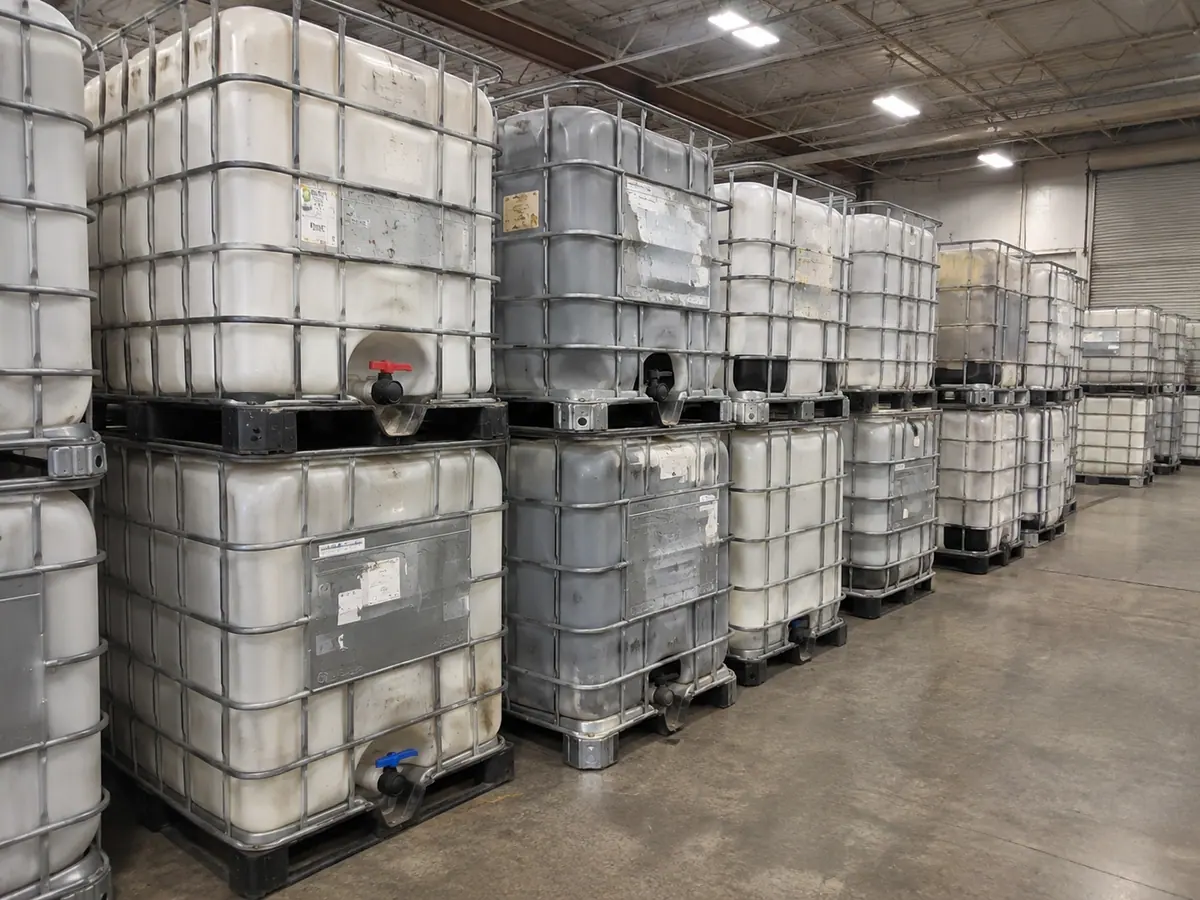
Intake is a refusal station
Every tote that arrives at Governors Row goes through intake before it goes anywhere near the wash line. Intake exists to say no. Roughly one arrival in eight gets turned away at the gate or routed straight to destructive recycling, and that number has been stable for years.
Every refusal is revenue we decline. A trailer that arrives with forty totes and leaves with twelve of them still on it is a bad morning commercially. We do it anyway, because every downstream station on the line assumes that the container in front of it is something we understand, and that assumption has to be true.
The list
Unknown or unlabelled prior contents. This is the biggest category by a wide margin. If we cannot establish what was in a container from paperwork or a legible label, we cannot assign it a grade, and a container without a grade is not a product.
Restricted-use pesticides. The regulatory and liability position is unambiguous and we do not go near it.
Acutely toxic products of any classification. Same reasoning, less ambiguity.
Crystallised or polymerised residue. Once a product has set inside a bottle, removing it safely costs more than the container is worth and risks the operator doing the removing.
Anything mixed on site by somebody who cannot tell us what they mixed. This happens more than you would expect, usually with the best of intentions.
What happens to a refused tote
If the problem is paperwork and the customer can find it, we hold the unit and wait. A surprising number of refusals resolve themselves with one email to a plant manager.
If the problem is the contents, the container goes to destructive recycling rather than back on the truck. The residual is captured and manifested, the bottle is granulated, the cage is baled. The customer pays for that service, and it is still considerably cheaper than disposal.
What never happens is the container going back out as a graded product. There is no version of this business where an unknown becomes a sale.
Why this is a buyer's issue, not just ours
When you are comparing suppliers on price, you are frequently comparing a yard that refuses one in eight against a yard that refuses none. The second yard will always be cheaper. It is cheaper because it is selling you the units the first yard declined.
The question worth asking a supplier is not “how do you wash them”. It is “what do you turn away, and how often”. If the answer is vague, or if it is “we can clean anything”, you have learned something useful about what is going to be in your container.
Written at 9003 Governors Row, Dallas. We publish these without a newsletter wall because gating a specification behind an email address is a small, petty thing to do. If something here is wrong, email us and we will correct it.