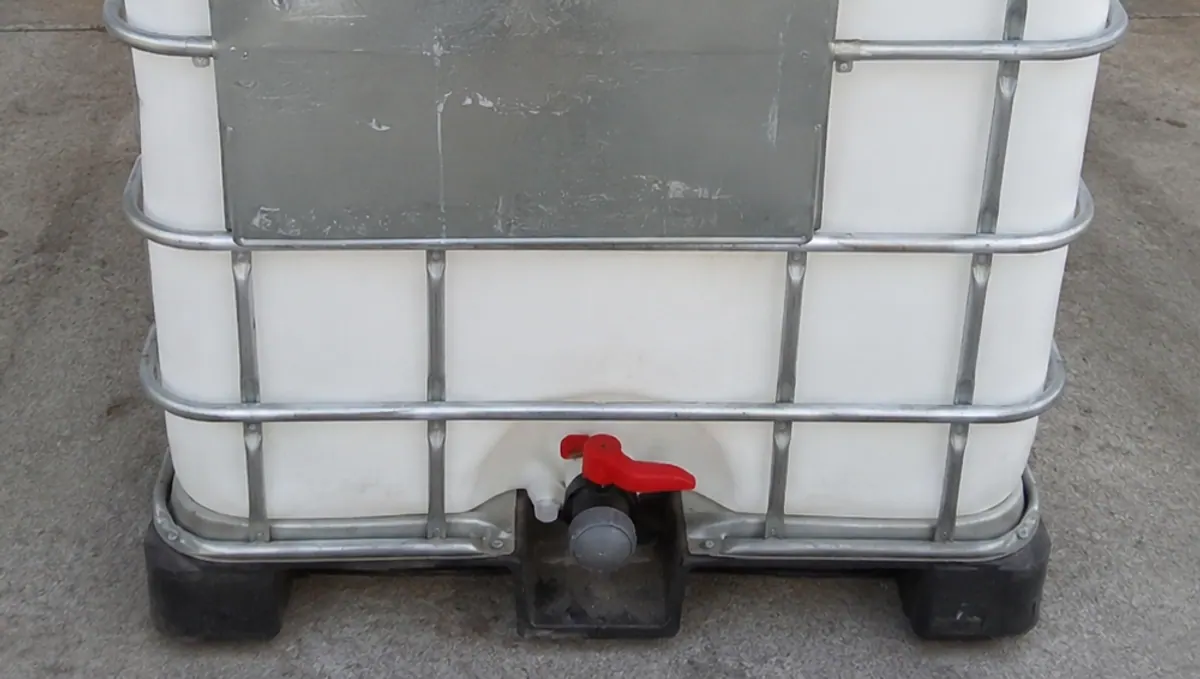
2 inch NPT, the North American default
If you are in the United States or Canada and looking at a caged poly tote, the outlet is almost certainly 2 inch NPT. The giveaway is that the thread is tapered: the diameter visibly reduces along the length, which is how the joint seals as it tightens.
NPT seals on the thread itself, which is why it wants PTFE tape or a thread sealant and why overtightening cracks plastic fittings. Hand tight plus one to two turns with a wrench, no more.
Buttress and S60x6, the imports
If the thread looks shallow, squared-off in profile and parallel rather than tapered, you are probably looking at a buttress thread, common on containers manufactured outside North America.
A 2 inch NPT fitting will start on a buttress thread, feel wrong after a turn and a half, and then cross-thread. People force it, damage both parts, and conclude the fitting was faulty.
Adapters exist and are inexpensive. The important thing is identifying the thread before you order, which is why we ask for the photographs.
Cam-lock and tri-clamp
Cam-lock is not a thread at all — it is a quick-connect with two hinged arms that clamp a grooved male adapter into a female coupler. It is fast, it is reusable, and it is the right answer anywhere a tote gets connected and disconnected daily. It typically bolts onto an NPT outlet via an adapter.
Tri-clamp is the sanitary standard: a flanged ferrule on each side, a gasket between, and a clamp around the outside. No threads in the product path, nothing to trap residue, fully cleanable. You will find it on stainless IBCs and essentially never on a poly tote unless somebody fitted an adapter.
The two photographs that solve this
First: straight on into the outlet, close enough that the thread profile is visible. We are looking for taper versus parallel, and for the shape of the thread crest.
Second: from the side, with a tape measure laid across the outer diameter of the thread. Nominal sizes are misleading — a 2 inch NPT male thread measures about 2.375 inches across the outside — so an actual measurement settles it.
With those two pictures we identify nine fittings out of ten without any further conversation. Without them we are guessing, and the parcel goes back and forth twice.
A short word on sealants
PTFE tape on tapered threads, wound in the direction of tightening, three to four wraps. Not on parallel threads or buttress, where the seal comes from a gasket and tape just jams the joint.
Never use PTFE tape on a tri-clamp. The gasket is the seal and tape in a sanitary joint is a contamination finding waiting to happen.
And never use pipe dope with a product you have not checked it against. Some sealants dissolve cheerfully in solvents and end up in your tank.
Written at 9003 Governors Row, Dallas. We publish these without a newsletter wall because gating a specification behind an email address is a small, petty thing to do. If something here is wrong, email us and we will correct it.