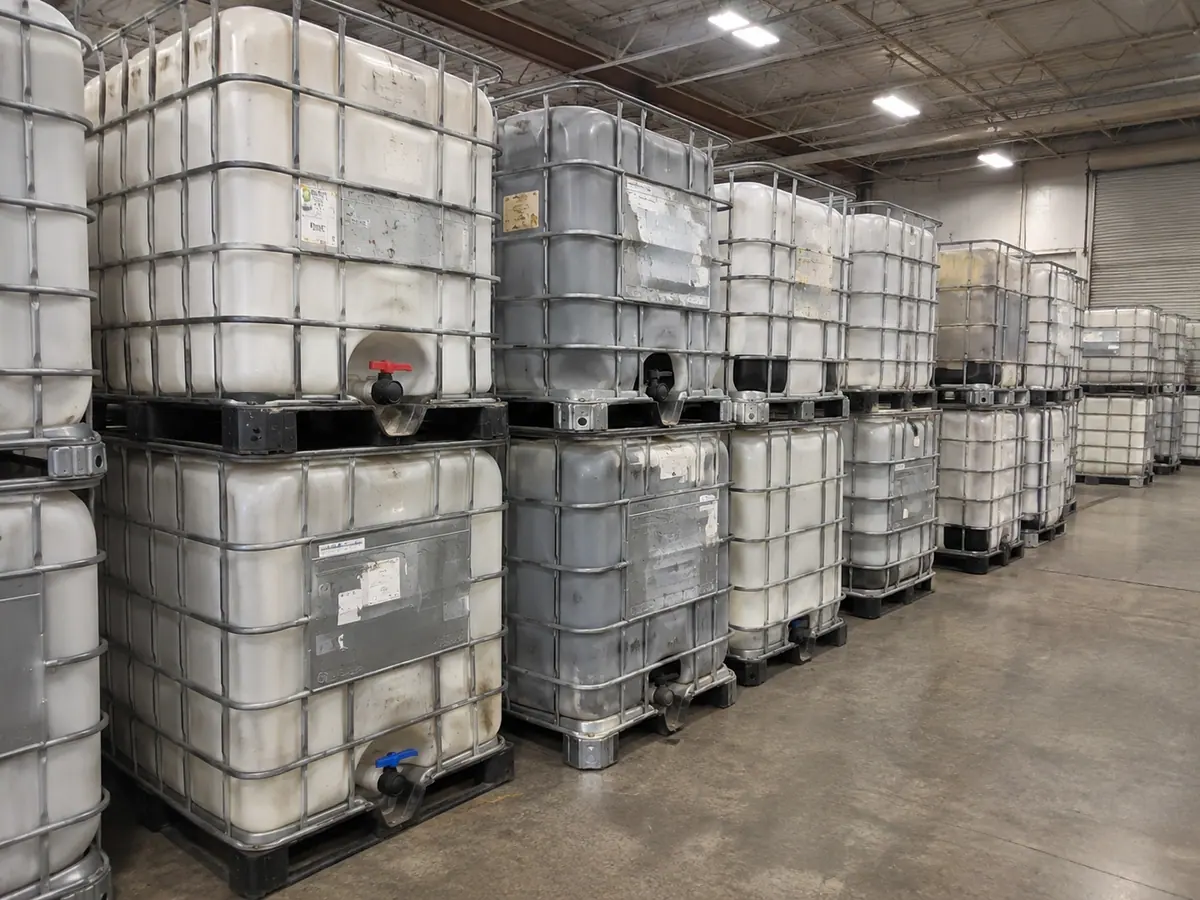
What permeation is
High-density polyethylene is not a perfect barrier. It is a dense tangle of polymer chains with spaces between them, and small molecules can work their way through those spaces over time, driven by concentration difference.
The result is that some products slowly migrate out through an intact, undamaged bottle wall. Nothing drips, nothing pools, the pressure test passes, and yet the container loses product and the air around it carries a smell.
Which products do it
Small non-polar molecules are the worst offenders: aromatic solvents, many hydrocarbons, some essential oils and fragrance compounds, and certain fuel components. If the molecule is small and likes being in a hydrocarbon environment, HDPE is a hydrocarbon environment.
Water-based products, acids, caustics, brines and most aqueous chemistry permeate negligibly. That is the vast majority of what moves in totes, which is why permeation is a niche concern rather than a universal one.
Heat accelerates it, sometimes dramatically. A product that permeates slowly at 60 °F can permeate several times faster at 100 °F, which is a good reason not to store marginal products in a sunlit yard.
The signs
A persistent smell around a container that has no visible leak and passes a pressure test. This is the classic presentation and it is frequently dismissed as residue on the outside.
Unexplained inventory loss over weeks. Not a sudden discrepancy, a slow drift.
Panelling or softening of the bottle wall, where the migrating product has plasticised the polymer. A wall that feels slightly tacky or unusually flexible has absorbed something.
Swelling. In the worst cases the bottle visibly grows, the cage becomes tight around it, and the unit becomes difficult to handle.
What to do about it
Check compatibility before you fill, not after. Your product supplier's safety data sheet usually names acceptable container materials, and if it says anything other than HDPE, believe it.
If the product is marginal, shorten the residence time. Permeation is a function of exposure duration — a tote that is filled and emptied within a fortnight behaves very differently from one that sits for six months.
Keep it cool and out of the sun. This is the cheapest intervention available and it is frequently sufficient.
And for anything genuinely aggressive, stop trying to make poly work. A stainless IBC has no permeation behaviour at all, and over a multi-year programme it is usually the cheaper vessel once you count the product you were quietly losing.
Written at 9003 Governors Row, Dallas. We publish these without a newsletter wall because gating a specification behind an email address is a small, petty thing to do. If something here is wrong, email us and we will correct it.