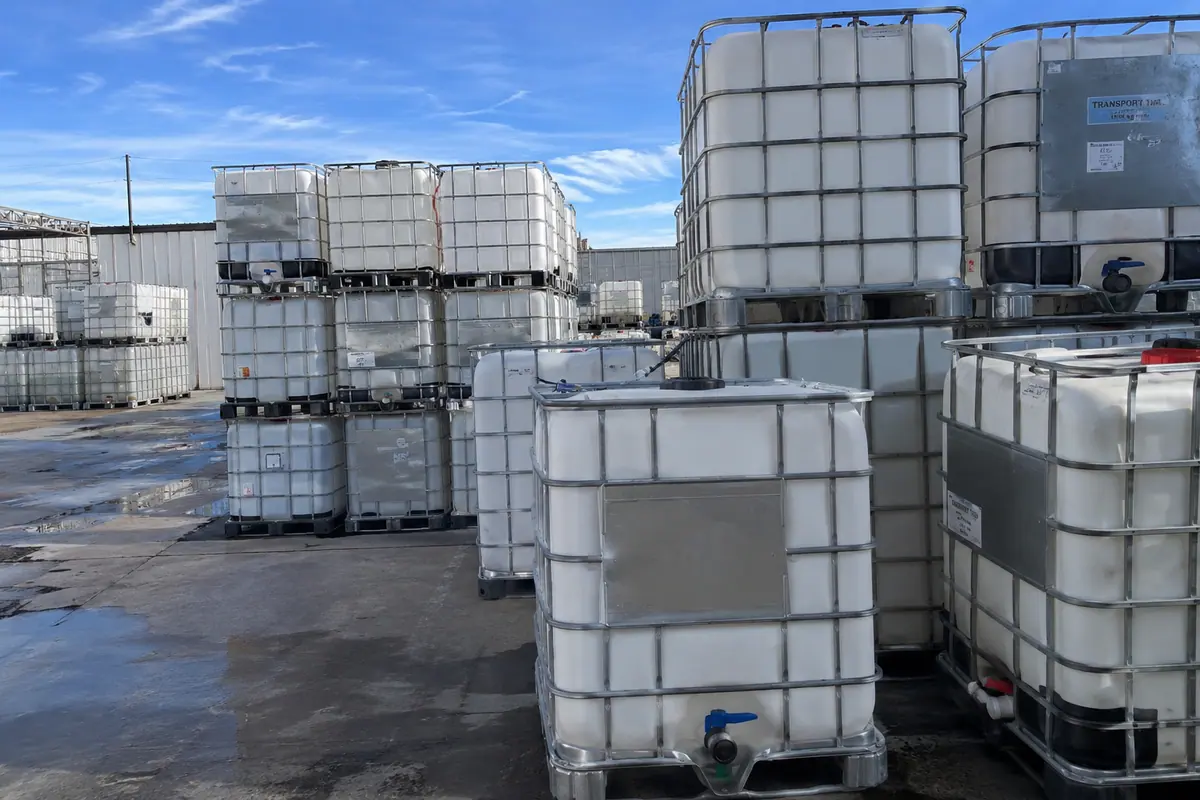
How a bottle gets condemned
Three routes. A breached wall, found at intake or during the wash. A residue we cannot remove safely — crystallised, polymerised or simply unidentifiable. Or a second failure of the 4 PSI pressure test after a return to the line.
Every condemnation is logged with a reason code, because the proportions tell us things. A rise in ultraviolet-related condemnations in a particular month usually means somebody's fleet has been sitting in a yard for two summers.
Teardown before granulation
The container is separated completely: bottle, cage, base, valve, lid, gasket. Fittings that are serviceable go to the parts shelf rather than into the shredder, which is why our accessory counter exists at all — a large share of the valves and lids we sell came off containers that did not survive.
Any remaining residue is captured and characterised before anything is cut, because a granulator is a very poor place to discover a product you did not expect.
The granulator itself
A rotating shaft with hardened blades passing close to fixed bed knives, inside a sealed chamber with a screen at the bottom. Material is reduced until it is small enough to pass the screen, which sets the particle size.
It is loud, it is dusty, and it is the only genuinely dangerous machine on the site. The interlocks are not negotiable and the maintenance schedule is not flexible.
Output is bagged HDPE regrind, graded by colour as far as we reasonably can — natural separately from mixed, because natural is worth meaningfully more.
Where regrind actually goes
Pipe and conduit, plastic lumber and decking, pallets, agricultural drainage, wheelie bins, non-food packaging. It is a real market with real buyers and we ship what we produce rather than stockpiling it.
What it does not become is new IBC bottles. Food and chemical containment specifications do not accept post-industrial regrind at the ratios that would require, so the material is down-cycled rather than circulated. That is a genuine limit on circularity, we did not invent it, and we are not going to pretend it away.
Why we treat this as a failure metric
Recycling recovers the material and spends the manufacturing energy again. Reuse keeps both. The gap is roughly an order of magnitude, which means every bottle that reaches this machine represents a container we did not manage to save.
Our internal target is for condemnations to fall as a share of arrivals every year. That is the opposite of how most companies report recycling tonnage, and it is a considerably more honest number.
Written at 9003 Governors Row, Dallas. We publish these without a newsletter wall because gating a specification behind an email address is a small, petty thing to do. If something here is wrong, email us and we will correct it.