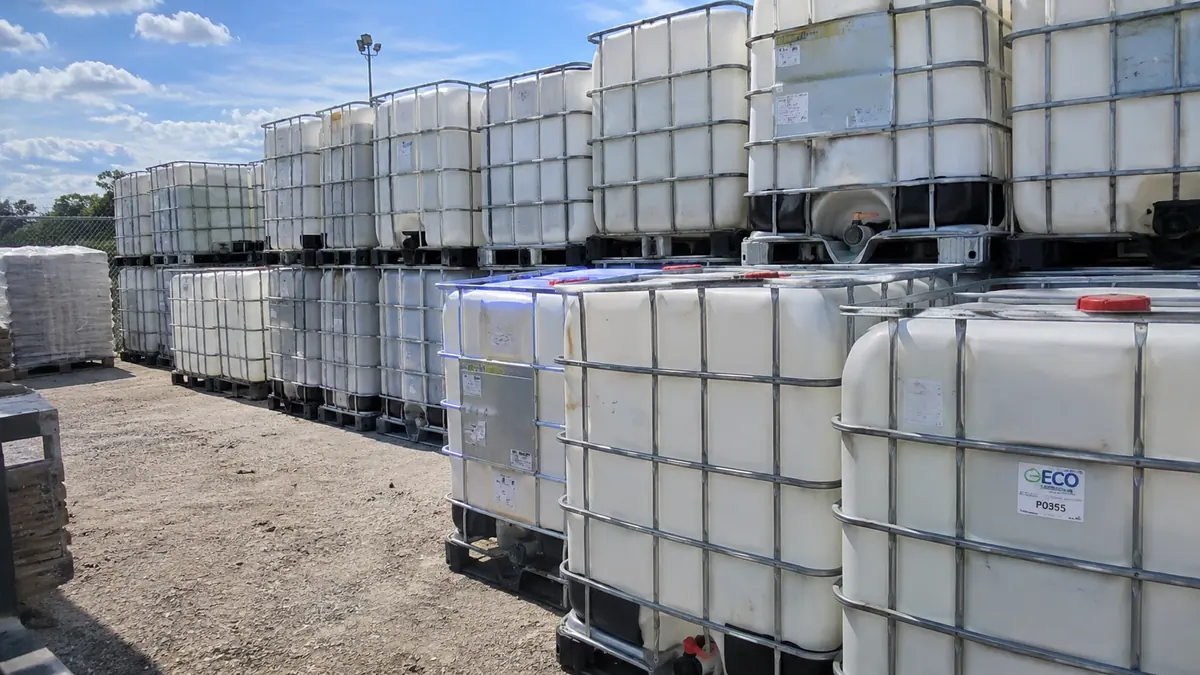
Where poly works fine
Cold storage of finished product, bulk juice and must handling, water treatment, cleaning solution storage, and transporting fruit or concentrate. A food-grade 275 does all of that cheerfully and costs a fraction of stainless.
A lot of small cideries and meaderies run their entire liquid handling on food-grade poly totes and there is nothing wrong with that. If your process is cold, short-contact and non-pressurised, poly is the economically rational choice.
The three things that cross the line
Heat. HDPE starts losing stiffness well before the temperatures used in a hot fill or a pasteurisation step. A tote that takes 170 °F product will deform between the cage bars, and will do it the first time rather than gradually.
Caustic clean-in-place. Repeated hot caustic cycles age poly, roughen the inner surface and shorten the life dramatically. Stainless was designed for exactly this and does not care.
Pressure. Carbonation, even modest, is outside what a composite IBC is designed for. These are atmospheric vessels. A bottle under pressure inside a steel cage is a bad shape of problem.
The sanitation argument
There is a fourth, slower reason producers move to stainless, and it is about verification rather than failure. A poly bottle's interior surface, after a few cycles, has microscopic texture. It can be cleaned, but it is harder to prove it is clean.
Stainless with a 2B or bead-blasted finish swabs clean, every time, and a tri-clamp fitting leaves nothing in the product path to harbour anything. When you reach the point where a customer or an auditor asks how you verify sanitation, that difference stops being theoretical.
The money, honestly
A food-grade poly 275 is around a hundred and eighty-nine dollars. A 350 gallon stainless IBC starts around eleven hundred and fifty. That is a real gap and nobody should pretend otherwise.
But the poly tote is a consumable in this application — heat and caustic will retire it in a couple of years — and the stainless vessel is not. Over five years with regular CIP, stainless is usually the cheaper vessel, and it carries no plastic in the loop at all.
Leasing exists for exactly this reason. It moves stainless from a capital decision to an operating one, which is frequently the thing actually blocking a small producer.
A sensible progression
Start on food-grade poly for everything cold. Buy one grade up, keep the prior contents letters on file, and paint or store out of light.
Add stainless at the first process step that involves heat or caustic, not across the whole operation at once.
And talk to us before you buy either, because we have talked more than one producer out of a purchase they did not need yet.
Written at 9003 Governors Row, Dallas. We publish these without a newsletter wall because gating a specification behind an email address is a small, petty thing to do. If something here is wrong, email us and we will correct it.