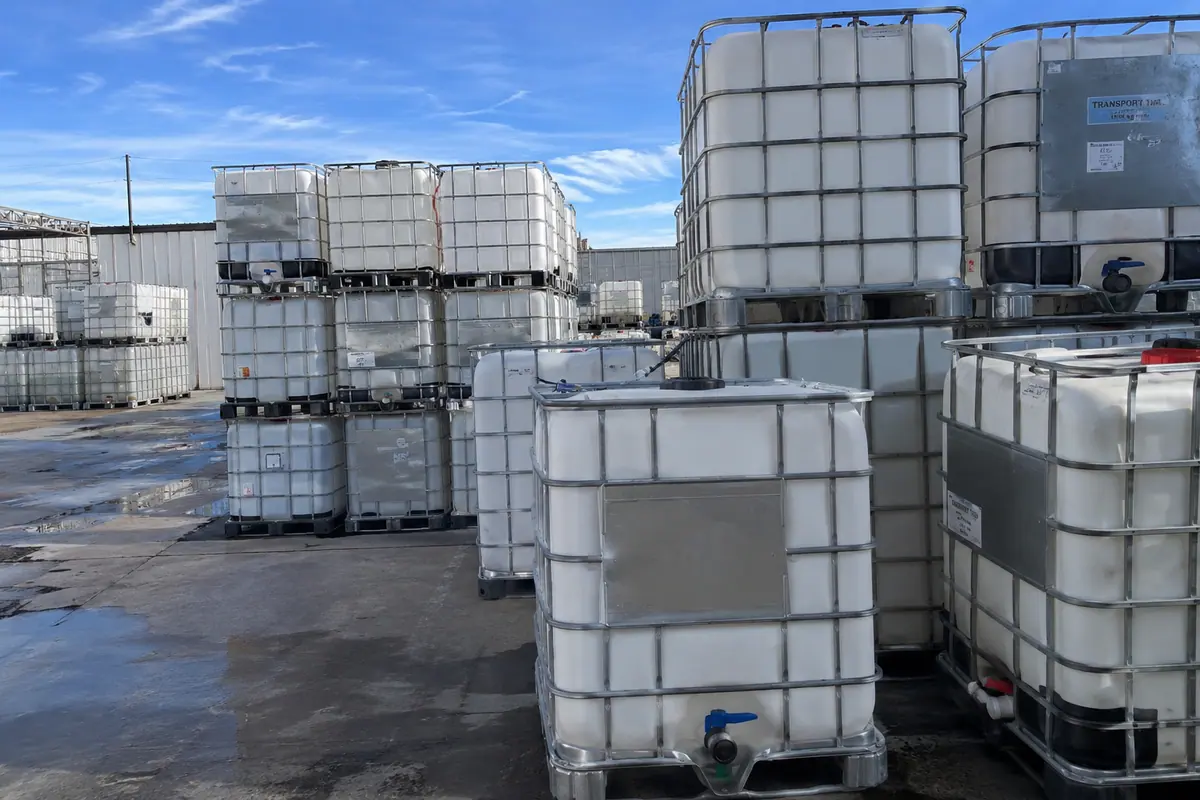
The costs of owning that never appear on a purchase order
Warehouse space holding empties waiting to go back out. Labour chasing containers that customers have not returned. The quarterly replacement purchase because the count never reconciles. Washing, or paying somebody to wash. And the write-off when a customer decides your container is now their container.
None of those sit on the line item that says “IBC tote, qty 40”. All of them are real and most plants have never totalled them.
What a pool actually changes
We own the containers. You draw clean, tested, labelled units against a committed monthly volume. Your customer empties them. We collect, wash, test and return them to the pool. You pay per turn.
Pool size is a function of turn time, not of monthly volume — how long a unit is away from the pool determines how many you need in it. We size for that and carry the cost of the spares.
Every unit carries a durable tag so the pool is counted rather than estimated, and the baseline is agreed in writing before anything starts.
Where the break-even sits
Around forty turns a month, in our experience, with two conditions attached: your customers need to be clustered enough that collection runs are efficient, and your product needs to tolerate a shared pool.
Below that, the collection economics do not work and buying is simply cheaper. We will tell you so rather than sell you a programme that will disappoint you in month four.
Above it, the gap widens fast, because every additional turn is a container that never had to be manufactured and a replacement purchase that never happened.
The environmental number, which customers increasingly want
An owned fleet in a typical plant turns perhaps twice a year, because nobody is paid to chase it. A managed pool turns six to ten times. Each additional turn avoids roughly 48 pounds of HDPE and 118 pounds of steel that would otherwise have been made.
Across a three-year programme at reasonable volume, that becomes a figure large enough that customers put it in their own annual reports. We issue it quarterly with the turn counts and the pool reconciliation behind it.
Where it does not work
Dedicated single-product containers that can never be cross-used. The whole efficiency of a pool is that units are fungible.
One-way export shipments. The container does not come back, so there is no loop to manage.
Allergen-sensitive food products and some specialty chemistry, which need a dedicated sub-pool. That is possible and it costs more, and we would rather say so at the start.
And anywhere the customer sites will not grant collection access windows. A pool you cannot collect from is just a slow way of giving containers away.
Written at 9003 Governors Row, Dallas. We publish these without a newsletter wall because gating a specification behind an email address is a small, petty thing to do. If something here is wrong, email us and we will correct it.