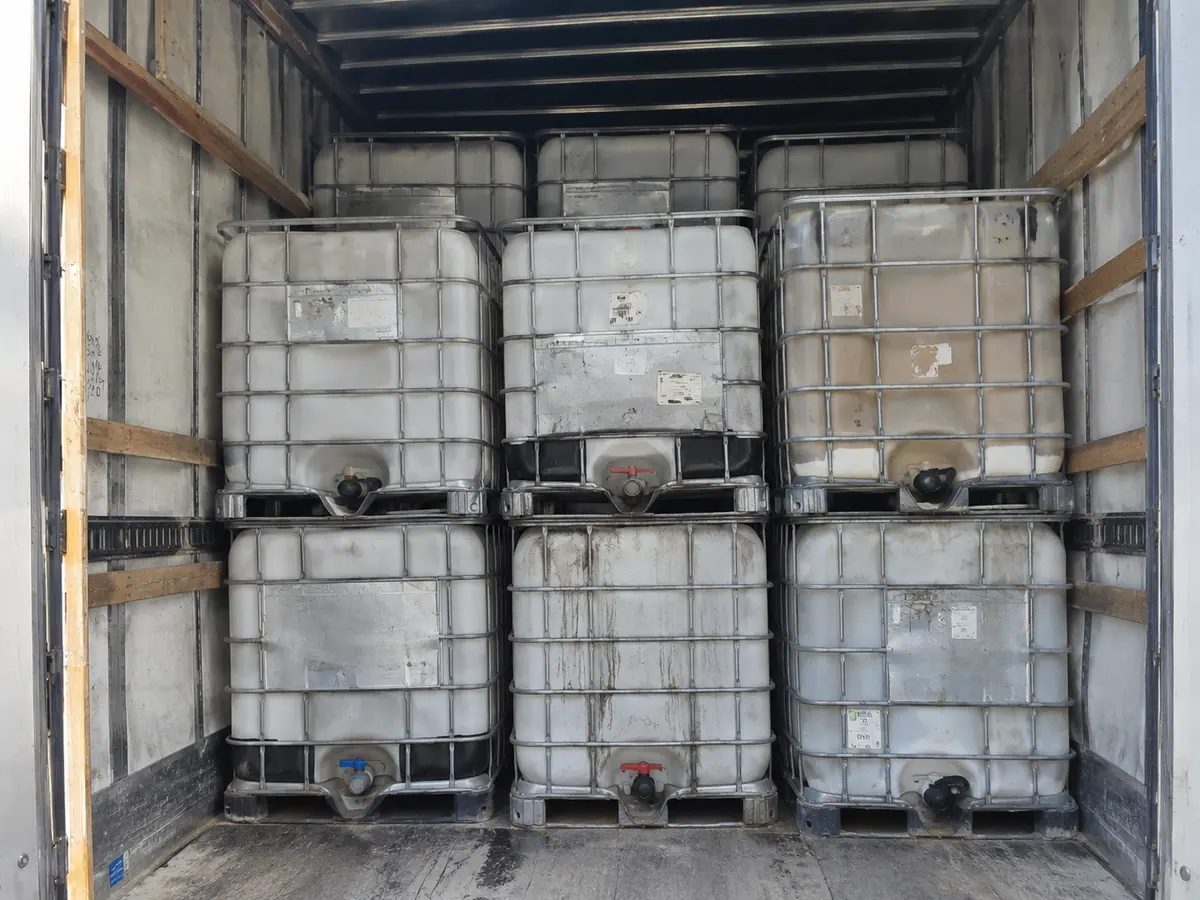
What a trailer floor actually holds
Twenty 275 or 330 gallon totes fill the floor of a 53 foot dry van. Not nineteen, not twenty-two — twenty, because the 48 by 40 inch footprint tessellates into that deck almost perfectly.
That single number drives the whole pricing structure. Below twenty you are buying less-than-truckload capacity and paying for the air around your pallets. At twenty you are buying a truck, and the truck costs what it costs regardless of whether you fill it.
Why four to nineteen is an awkward range
In that band you are on LTL, and LTL prices on density. Empty IBC totes are about the least dense thing you can legally put on a trailer — roughly 2.4 pounds per cubic foot — which puts them in expensive freight class bands.
The practical consequence is that your per-unit landed cost barely improves between six totes and sixteen. You are paying a density penalty either way. Customers often work very hard to get from eight units to twelve and are disappointed by how little it saves.
And why twenty changes the picture
On a dedicated truckload the density question disappears entirely. You are paying for a trailer and a driver and a lane, and the freight cost per container is simply the lane rate divided by twenty.
On a typical 600 mile lane that can halve your per-unit freight compared with LTL at twelve units. It is the single biggest lever most buyers have, and it costs nothing but planning ahead.
Four ways to reach the cliff
Buy ahead of your season instead of into it. De-icer and fertigation customers who order in the quiet months get a truckload rate; the ones who order in the rush get LTL and a queue.
Mix grades on one order. Ten technical, six as-is and four food grade is still a trailer floor, still one invoice, still one truck.
Combine with a collection. If we are coming to you anyway to buy empties, the inbound leg is already paid for.
Talk to a neighbour. We have shipped shared trailers to two businesses on the same industrial estate more than once, and both saved real money.
When not to chase it
If you genuinely only need six totes, buying twenty to get a better unit rate is false economy — you have just converted a freight saving into standing inventory and yard space.
And if you are more than about 1,600 miles from Dallas, the whole calculation shifts. At that distance we will often tell you to buy locally, because no amount of order consolidation beats not shipping air across the country.
Written at 9003 Governors Row, Dallas. We publish these without a newsletter wall because gating a specification behind an email address is a small, petty thing to do. If something here is wrong, email us and we will correct it.