The volume maths
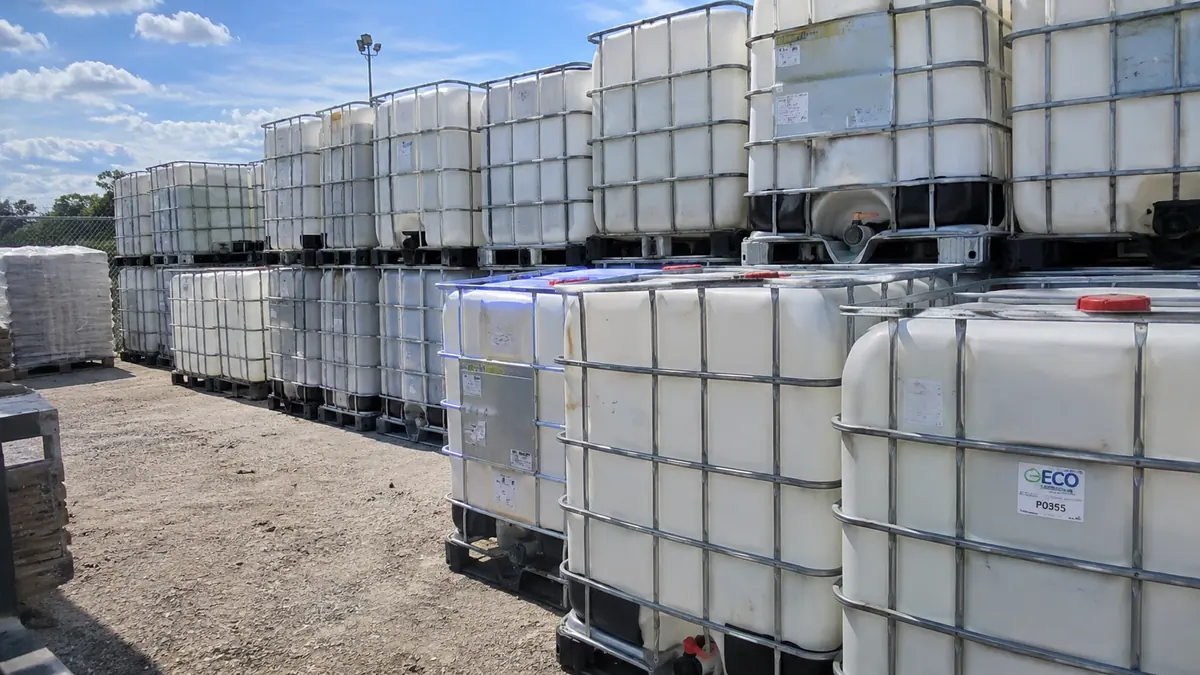
A 55 gallon drum holds 55 gallons, obviously, and occupies about 4.6 square feet of floor including the handling clearance you actually need. A 275 gallon tote holds five drums' worth on 13.3 square feet. A 550 gallon tote doubles that again on 17.8.
So on pure floor efficiency the tote wins decisively and the tank wins even harder. But floor space is rarely the binding constraint. Handling is.
What each one costs you in labour
Drums require a drum truck, a lift, or a pair of people, and every transfer is a separate operation. Six drums is six bung openings, six pumps or six tips, six bits of paperwork if you are tracking lots.
A tote is one valve. One connection, one transfer, one record. The labour saving over drums is substantial and it is usually the real reason plants switch, not the price per gallon.
A fixed tank is the lowest handling cost of all, and the highest commitment. You cannot move it, you cannot easily change what is in it, and cleaning it between products is a confined-space job rather than a swap.
Where drums still win
Small quantities of expensive or short-shelf-life product. You do not want 275 gallons of something you use eight gallons of a month.
Multiple products in a small space. Six drums can be six different chemistries. One tote is one.
Anywhere the receiving customer cannot handle a 2,400 pound unit. A lot of smaller sites have no forklift and no dock, and a drum on a hand truck is the only thing that gets through the door.
Regulated hazmat in small quantities, where drum packaging approvals are simpler and more widely understood.
Where the tank wins
Single product, high and steady throughput, one location, and a supplier who will deliver by tanker. Above roughly 2,000 gallons a month of one thing, a tank with a bund usually beats any container strategy on total cost.
The moment any of those conditions wobbles — two products, a seasonal pattern, a second site — the flexibility of containers starts earning its keep again.
The honest recommendation
For most industrial users moving between 200 and 2,000 gallons a month of a non-exotic liquid, the tote is the right answer, and a reconditioned one does the job as well as a new one.
Start there, keep two spares, write the return trip into your purchase, and revisit the decision when your volume changes by a factor of three. That is a better policy than optimising the vessel choice every quarter.
Written at 9003 Governors Row, Dallas. We publish these without a newsletter wall because gating a specification behind an email address is a small, petty thing to do. If something here is wrong, email us and we will correct it.