Start with the classification
Fire codes care about what the liquid is before they care about what it is in. Flammable and combustible liquid classifications drive quantity limits, separation distances, sprinkler design and whether you need a dedicated room at all.
If your product has no flash point and is water-based, most of the specific liquid provisions do not apply to you, and you are in general storage territory. That covers the large majority of what moves in totes.
Why plastic is treated differently
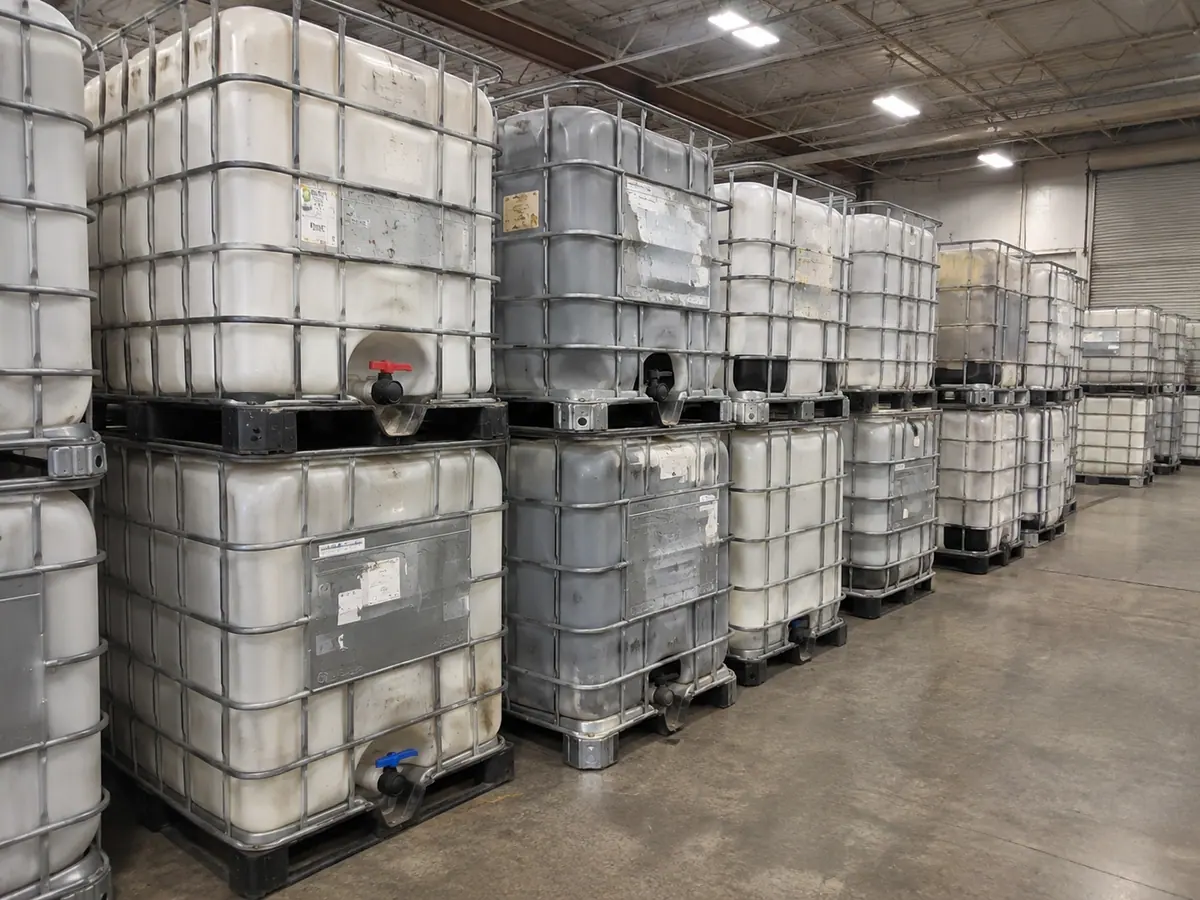
A steel drum in a fire contains its contents for a while and fails in a reasonably predictable way. A plastic IBC does not — the bottle softens and loses integrity early, releasing the entire contents at once onto the floor of a burning building.
That behaviour is why composite IBCs attract specific attention in sprinkler design standards, and why protection schemes developed for drums do not simply transfer. If you are storing flammables indoors in composite IBCs in quantity, this is a conversation with a fire protection engineer, not a decision to make from a website.
The things that are usually in scope
Maximum allowable quantity per control area, which depends on classification, whether the area is sprinklered and whether the containers are in approved cabinets or rooms.
Sprinkler density and arrangement, including in-rack sprinklers for stacked storage. Stacking composite IBCs two high changes the protection requirement meaningfully.
Separation and aisle widths, which also happen to be what makes a yard workable day to day.
Secondary containment, which the fire code and the environmental rules both care about for different reasons and frequently to different volumes.
Electrical classification in the storage area where flammable vapours may be present.
Practical steps that are almost always right
Keep flammables out of composite IBCs entirely unless the whole system was designed for it. This resolves most of the difficulty before it starts.
Do not stack filled totes indoors unless your sprinkler design accounts for it. Two high is a protection decision, not a space decision.
Keep containers away from exits, electrical panels and anything that is part of the means of escape.
Label everything legibly, in a way that an incident commander can read from a distance. The person who most needs to know what is in your totes is somebody who has never been in your building.
Talk to your authority having jurisdiction early. They are considerably more helpful before an installation than after one.
What we can and cannot help with
We can supply containers to a specification, tell you what grade and material suits your product, and document what was in a container previously.
We cannot tell you what your local code requires, and we are suspicious of any container supplier who offers to. Codes are local, they are amended, and the person who signs off on your installation is not us.
Written at 9003 Governors Row, Dallas. We publish these without a newsletter wall because gating a specification behind an email address is a small, petty thing to do. If something here is wrong, email us and we will correct it.