Why plastic is the problem
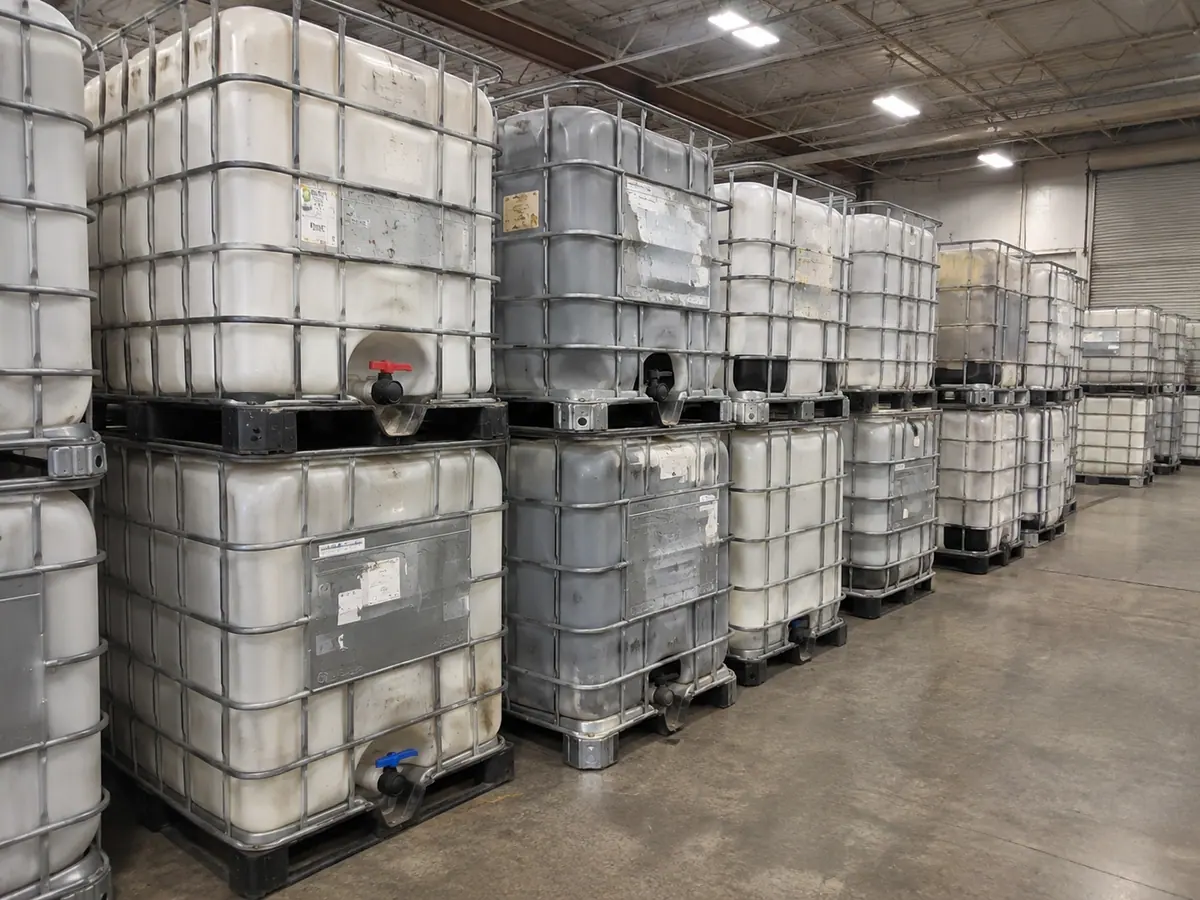
When a liquid flows through a pipe or splashes into a container, charge separates. In a steel drum that charge runs to earth through the drum body, provided the drum is bonded and grounded. In a plastic bottle it does not run anywhere, because the plastic is an insulator.
Charge therefore accumulates on and in the bottle. If the headspace happens to contain a flammable vapour and air mixture within its explosive range, a discharge in that space is an ignition source. The steel cage around the bottle does nothing to help, because the cage is not in contact with the liquid.
The practical rule
Standard composite IBC totes are not appropriate for flammable liquids with a low flash point unless the whole system has been designed for it. That is not us being cautious — it is why conductive and dissipative IBC variants exist as separate products with different nameplates and a meaningfully higher price.
If you are handling Class I flammables, you want a conductive or static-dissipative IBC, or you want steel, and you want the fill system bonded and grounded with a verified connection rather than a wire that somebody clips on optimistically.
Things that make it worse
Splash filling. A free-falling stream into a headspace generates far more charge than a dip pipe that discharges below the liquid surface. If you take one thing from this article, take the dip pipe.
High fill rates. Charge generation rises with velocity. Slow the first part of the fill until the dip pipe outlet is submerged.
Dry conditions. Low humidity means less surface conduction and more charge retention. Winter is worse than summer.
Filtration immediately upstream. Filters are prolific charge generators, and a filter close to the fill point gives the charge no residence time to relax before it arrives in the container.
What we will and will not sell you
We sell standard composite totes, and when somebody tells us they are filling a solvent we ask what the flash point is. If the answer puts it in flammable territory, we decline the sale and explain why, and we point at conductive IBCs or steel instead.
We do not re-certify containers for flammable service. Nobody should, outside the original design-type approval framework.
And we will not sell an as-is or technical-grade tote to anybody who tells us it is going to hold fuel for anything other than a stationary, bunded, non-dispensing application — and even then we would rather they bought steel.
This is one of the few places in this trade where the cheap answer and the right answer are genuinely far apart, and the gap is measured in consequences rather than dollars.
Written at 9003 Governors Row, Dallas. We publish these without a newsletter wall because gating a specification behind an email address is a small, petty thing to do. If something here is wrong, email us and we will correct it.